Social Icons

Pages

Tampilkan postingan dengan label England. Tampilkan semua postingan

Minggu, 19 Mei 2013

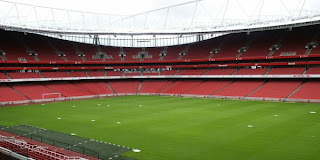
The Empire Of Arsenal


This is like a new empire of Emirates. With 60.361 Capasitors, The Emirates Stadium replaced Arsenal’s previous home Highbury, which had become too small and lacked the possiblities for expansion being hemmed in by housing.


First plans for the construction of a new stadium were made in the late 1990s, but also a move to the new Wembley Stadium was considered.
In the end a site was chosen just a few hundred yards away from Highbury, and, after a few delays, construction of the stadium started in 2004. The total project budget amounted to £390 million.
The Emirates Stadium officially opened on the 23rd of July 2006. The first match was a testimonial match for Dennis Bergkamp featuring an Arsenal and Ajax side.
Due to the competition of nearby Wembley Stadium, the Emirates Stadium has never hosted the English national team, however the Brazilian national team has regularly staged friendlies at the stadium.
The Emirates Stadium is located in the Islington area, slightly north of the centre of London and just over 2 miles north from Kings Cross St Pancras railway station.
The stadium is best reached by metro. The nearest tube station is Arsenal, on the Piccadilly line. Alternatives are stations Finsbury Park (Victoria and Piccadilly line) and Highbury & Islington (Victoria line and North London Line). From both stations it is a 10-minute walk to the stadium. Holloway Road and Drayton Park stations will be closed pre-match and are exit-only after the match.
Finsbury Park and Highbury & Islington stations can also be reached by train. It is a 5-minute journey coming from either Kings Cross or Moorgate station.
Supporters are not advised to arrive by car on matchdays, and there is little parking available around the Emirates Stadium on non-matchdays

Theatre Of Dreams From Manchester


In March 1909, Manchester United chairman and general benefactor, John Henry Davies, funded the purchase of a piece of land between the canal and the railway at Trafford Park. Archibald Leitch was appointed architect and plans were drawn for the construction of a large, lavish football stadium. Old Trafford, as it was duly named, was built in under a year and opened on 19 February 1910. With a capacity of 60,000 and a 13,000 seat Main Stand, it was thought to be the best stadium in the country.

Debts incurred in building the new stadium meant it was some time before further developed could be afforded. It wasn’t until the 1930s that roofs were added to other parts of the ground. The ‘popular side’, opposite the Main Stand, got a roof in 1936 and the corners next to the main stand became covered in 1938. Sadly, the improved ground then came to grief. During a night of bombing on 11 March 1941 Old Trafford took two direct hits: one virtually demolished the Main Stand and the other destroyed a bank of terracing and left a large crater in the pitch. For the next eight years Manchester United had to play official home games at Maine Road, home of neighbours Manchester City.
Old Trafford wasn’t fit to be used again by the first team until August 1949. Even then there was still further work to be done. In the austerity years after the war neither money nor building materials were in plentiful supply. The ground slowly improved during the 1950s. A new roof on the Main Stand was completed in 1951, in 1957 floodlights were erected allowing the playing of evening games and, in 1959, the Stretford End was also covered.
In the 1960s many English grounds were improved in readiness for the 1966 World Cup. Manchester United received a grant which helped fund the building of a large new cantilever stand on the ‘popular’ (United Road) side of the ground. Designed by architects Mather and Nutter, it was the first in the country to include private boxes. This stand was later extended to also cover the Scoreboard End and, by the mid-1970s, a cantilever roof also replaced the roof of the Main Stand. In 1974 perimeter fencing began to be erected to keep in exuberant supporters, and shortly afterwards an Executive Suite was created to attract wealthier supporters. In 1987 the floodlight pylons were replaced by lights fitted to the stand roofs. Then, during the 1992-1993 season, the Stretford End was demolished and re-developed to complete a stadium bowl.
Just when it seemed Old Trafford was in a finished state, a further process of re-development began. Following the Hillsborough disaster, the Taylor Report recommended the creation of all-seater stadia. This reduced the seating capacity at Old Trafford to just 44,000 at a time when the team’s success was generating greater demand for tickets. In 1995-1996 a new three-tier North Stand was built, designed by Atherden Fuller (formerly Mather and Nutter). Between 1999 and 2000 extra tiers were added to the East Stand and West Stand and in 2005-2006 the north-east and north-west quadrants were filled in. The resulting capacity rose to over 76,000.
Old Trafford is now recognised as one of the best football grounds in Europe. It has lately hosted FA Cup semi-finals, a UEFA Champions League final and various international matches. In 2010 Old Trafford celebrated its centenary.